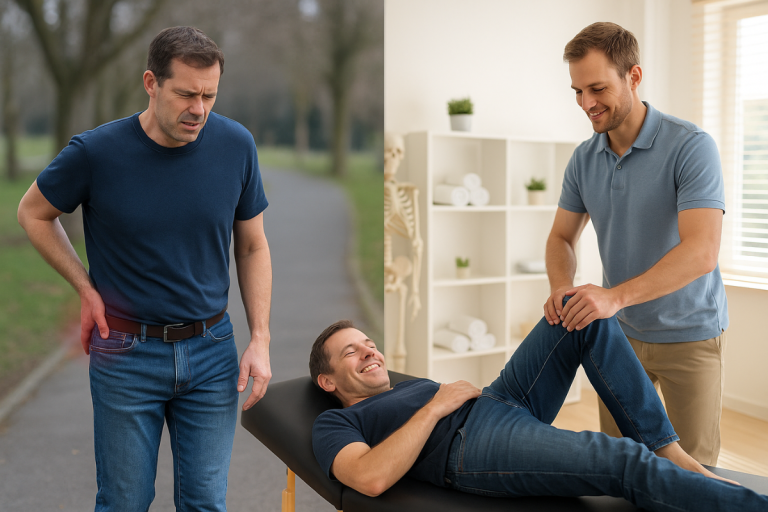
It happens in an instant. A missed step off a curb, an awkward landing during a match, or a simple roll on uneven ground. Suddenly, you’re hit with sharp pain, and your ankle starts to swell. You’ve just joined the thousands of people who experience an ankle sprain every year. Your first thought is likely the classic advice you’ve always heard: RICE (Rest, Ice, Compression, Elevation).
The RICE Method Is Not Enough: Proper Ankle Sprain Rehab in Dundalk
While the RICE protocol is a crucial first step to care for a sprained ankle in the first 48 hours, it’s exactly that—a first step. It’s brilliant for managing the initial pain and swelling, but it does very little to address the underlying ligament damage or restore the function you need for a full, stable recovery. To truly know how to heal a sprained ankle fast and effectively, you need to look beyond RICE and embrace a structured rehabilitation program.
What is an Ankle Sprain and What are the Different Grades?
An ankle sprain occurs when you stretch or tear one or more of the ligaments in the ankle. Ligaments are the tough, fibrous bands that connect bones to other bones and provide stability to the ankle joint. The severity of the sprain is classified into different grades of ankle injury:
- Grade 1 Sprain: A mild stretch of the ligament fibers. You’ll have some mild tenderness and swelling, but you can usually walk with minimal pain.
- Grade 2 Sprain: A partial tear of the ligament. This results in more significant pain and swelling, a visible bruise, and some joint instability.
- Grade 3 Sprain: A complete torn ligament. This is a severe sprain with major swelling, pain, and the inability to bear weight. A doctor or physical therapist may order an X-ray to rule out a broken bone.
Beyond RICE: The Four Pillars of a Full Sprained Ankle Recovery
Relying only on RICE for a Grade 2 or Grade 3 sprain is a recipe for problems down the line, including chronic ankle instability and a higher risk for future ankle sprains. A proper ankle sprain treatment in Dundalk guided by a physio for sprained ankle focuses on a multi-phase approach.
1. Regaining Your Range of Motion
After the initial swelling subsides, the first goal is to gently restore movement. Stiff scar tissue can form if the joint is kept still for too long. Your physical therapist will guide you through gentle exercises like ankle alphabets (tracing the letters with your big toe) to improve your range of motion without stressing the healing ligaments.
2. Strengthening Exercises
This is the most critical part that RICE misses. The muscles around your foot and ankle are your “active” stabilisers. We need to strengthen them to support the now-weakened “passive” stabilisers (your ligaments). Your ankle rehabilitation exercises will progress from simple resistance band work to more functional movements.
3. Restoring Proprioception (Balance and Joint Awareness)
Proprioception is your body’s ability to sense its position in space. After a sprain, the nerve endings in your ligaments are damaged, which impairs this sense. This is why you might feel your ankle is “wobbly” or untrustworthy. Exercises like standing on one leg (first on a stable surface, then on an unstable one) are essential to retrain this sense and prevent sprains in the future.
4. Sport-Specific Training
The final phase is a gradual return to your sport or activity. This involves drills that mimic the movements you need—running, cutting, jumping, and landing—to ensure your ankle can handle the demands without re-injury.
Common Mistakes to Avoid During Your Recovery
- Applying Heat Too Soon: Avoid hot baths and heat packs for at least the first couple of days, as this can increase swelling. Stick to an ice pack.
- Returning to Sport Too Early: Feeling no pain doesn’t mean the ligament is fully healed and strong. Following a full rehab plan is key.
- Ignoring the Injury: “Walking it off” with moderate to severe ankle sprains is a surefire way to develop a chronic ankle sprain.
A sprained ankle might be a common injury, but its treatment should not be taken lightly. A comprehensive treatment plan is your best bet for a fast, strong, and stable recovery.
If you’ve recently sprained your ankle, don’t leave your recovery to chance. Contact Felix Jose Chartered Physiotherapy for a professional assessment and a personalized ankle rehabilitation plan.