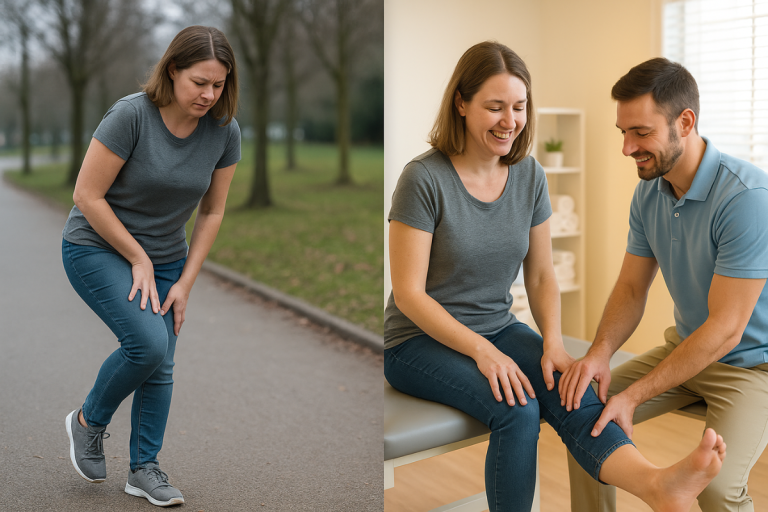
You’re halfway through your run along the Navvy Bank, or in the middle of a tough training session at the local club, when you feel it: that unwelcome, nagging knee pain. It’s a frustrating and all-too-common experience for athletes in Dundalk. The big question is, what exactly is causing it? While many people group all anterior knee pain together, two of the most frequent culprits—Runner’s Knee and Jumper’s Knee—are distinct conditions that require a specific approach to heal properly.
Runner’s Knee vs. Jumper’s Knee: A Physio’s Guide for Athletes in Dundalk
Understanding the difference between these two conditions is the first and most critical step in your recovery. Both are typically overuse injuries, meaning they develop from repetitive strain on your knees rather than a single traumatic event. However, they affect different structures within the knee joint, and misdiagnosing the problem can prolong your recovery time. As your local sports physio in Dundalk, we want to clear up the confusion.
What is Runner’s Knee (Patellofemoral Pain Syndrome)?
Runner’s knee, technically known as patellofemoral pain syndrome (PFPS), is one of the most common cause of runner’s knee pain. The name is a bit of a giveaway: the issue lies at the patellofemoral joint, where your kneecap (patella) glides over your thigh bone (femur).
The key symptoms of runner’s knee include:
- A dull, aching pain in the front of the knee, often felt around the kneecap or behind it.
- Pain that gets worse when you bend and straighten your knee repeatedly, such as with running, climbing stairs, or doing a squat.
- A grinding or clicking sensation when you move your knee.
- Pain after sitting for a long time with your knees bent (sometimes called “movie-goer’s knee”).
The primary runner’s knee causes are usually related to biomechanics. This can include muscle imbalances (like weak or tight quadriceps or hamstring muscles), poor foot mechanics like flat feet, or improper tracking of the knee cap.
Understanding Jumper’s Knee (Patellar Tendinopathy)
While it also causes pain at the front of the knee, Jumper’s Knee is a different beast. This condition is an injury to the patellar tendon, the strong cord that connects your kneecap to your shinbone. It’s an inflammatory or degenerative condition caused by the high loads from explosive movements.
The classic jumper’s knee symptoms are very specific:
- A sharp, localized pain directly below the kneecap, at the bottom point of the patella.
- The area is often tender to the touch.
- The pain gets worse with activities that load the tendon, such as jumping, landing, or pushing off to sprint.
This is why it’s so common in athletes who play basketball, volleyball, and Gaelic football.
The Crucial Difference: How to Tell Them Apart
So, how can you tell if you may have runner’s knee or jumper’s knee? The simplest way is to pinpoint the exact location of your pain:
- Runner’s Knee (PFPS): The pain is generally diffuse, felt around or under your kneecap.
- Jumper’s Knee: The pain is highly localized to a specific spot just below your kneecap.
If you are experiencing knee pain from running, paying attention to this detail can give your physical therapist a huge clue as to the cause of your knee pain.
Finding the Best Knee Treatment and Path to Recovery
While some mild cases can be treated at home with rest and ice, persistent knee symptoms require a professional treatment plan. At our Dundalk clinic, we start with a thorough physical exam and ask about your symptoms to get an accurate diagnosis.
A comprehensive plan for runner’s knee treatment in Dundalk often includes:
- Pain & Swelling Management: Modifying activities (which doesn’t always mean you have to stop running completely) and using ice to relieve pain.
- Strengthening Exercises: This is key. We focus on strengthening the quadriceps, hips, and glutes to better support your knee.
- Stretching & Mobility: Addressing tightness in the hamstring or iliotibial band, which can also lead to knee pain.
- Biomechanical Analysis: Looking at your running form, footwear (like your running shoe), and whether custom orthotics could help.
A knee brace is sometimes used for short-term support, but our goal is to strengthen your body so you don’t need one. Surgery is rarely required to treat runner’s knee.
How to Prevent Injury and Keep Your Knees Healthy
The best knee treatment is prevention. To prevent pfps and other knee issues:
- Warm up properly before every session.
- Incorporate strengthening exercises into your weekly routine.
- Avoid sudden, drastic increases in your training volume or intensity.
- Invest in proper footwear and replace it regularly.
Don’t let knee pain stop you in your tracks. Understanding the cause is the first step to getting back to the sport you love, pain-free.
If you are experiencing persistent knee pain, don’t guess the cause. Contact Felix Jose Chartered Physiotherapy for a professional assessment and a personalized plan for knee pain relief in Dundalk.